

US Secretary of State Marco Rubio, during his recent visit, characterized Greece as an «irreplaceable ally» of NATO and announced new arms deals worth billions, while promising that the US will not permit a Greek-Turkish conflict.
Behind the diplomatic pleasantries, however, emerges a deeper problem: the ever-greater military, energy, and geopolitical dependence of Athens on a superpower that continues to regard Turkey as an irreplaceable strategic partner.
The critical question is not how useful Greece is to Washington, but how independent it remains when American interests clash with Greek ones.
The visit of Rubio to Athens on October 7 was presented by the Greek government as yet another historic affirmation of the strategic relationship between Greece and the United States.
The head of American diplomacy characterized Greece as an «irreplaceable partner» of NATO and a pillar of stability in the Eastern Mediterranean.
Concurrently, American military sales totaling 4 billion dollars were announced, alongside enhanced cooperation in counter-terrorism intelligence sharing and further deepening of energy ties.
The announcements caused satisfaction in Athens.
However, behind the image of a robust strategic partnership, a fundamental question takes shape that is systematically avoided in public discourse: Is Greece genuinely strengthening as an autonomous geopolitical actor, or is it gradually transforming into an increasingly dependent link in American strategy, devoid of corresponding guarantees for its national interests?
Because strategic relationships are not judged by the compliments of officials, but by the tangible commitments undertaken by each side and the cost each is prepared to incur when a crisis arises.

The promise and hidden bombshell of Rubio revealed the true problem
Of particular significance was the reassurance from Marco Rubio that a military conflict between Greece and Turkey is «unthinkable» and that the United States could not allow such a development.
The US Secretary of State argued that both countries are allies in NATO and that a clash between them would harm not only themselves, but also the United States.
The assurance sounds comforting.
Yet, it also exposes the limits of American policy.
If the participation of Greece and Turkey in the same military alliance constituted in itself a guarantee of peace, there would be no need for public intervention by Washington.
More importantly, the American statement aims at deterring a conflict, not recognizing specific Greek positions regarding the continental shelf, the EEZ, or sovereign rights.
Washington promises it will not allow war, but does not commit to supporting Athens against every Turkish challenge.
This is the critical distinction between allied cooperation and a genuine national security guarantee.

Greece pays billions - Who secures Greek interests?
The new agreement for American weapons systems valued at 4 billion dollars forms part of a broader military modernization program.
The procurement of F-35 fighter jets, the upgrade of F-16 aircraft to the Viper configuration, and the acquisition of advanced missile systems undoubtedly bolster significant operational capabilities of the Hellenic Air Force.
However, these agreements also entail long-term financial, technological, and operational commitments.
Maintenance, support, upgrades, and access to critical technologies remain substantially tethered to American suppliers.
Here lies one of the greatest dangers of contemporary Greek strategy.
Acquiring modern American armaments constitutes a legitimate and necessary choice when it addresses defense needs.
When accompanied by excessive dependence on a single supplier, however, it creates constraints on the freedom of future decision-making.
The issue is not to question the necessity of robust Greek Armed Forces.
It is to examine whether enormous expenditures generate corresponding Greek strategic autonomy.
A country that purchases advanced weapon systems but depends increasingly on third-party decisions for their long-term maintenance has not necessarily solved its security dilemma.
It may simply have shifted a significant part of it to a different plane.

Souda and Alexandroupoli: Strategic assets or cession of geopolitical power?
The American military presence in Greece constitutes a central pillar of bilateral cooperation.
Souda offers substantial naval and air support capabilities in the Eastern Mediterranean, while Alexandroupoli has acquired distinct value for military logistics transit and access to southeastern Europe.
The significance of these installations was explicitly acknowledged by Greek Foreign Minister Giorgos Gerapetritis in joint statements with Marco Rubio.
Yet the geographical value of Greece creates a fundamental question of bargaining power.
What exactly does Athens derive from the expanding utilization of Greek infrastructure in support of American military designs?
Is Greek deterrence capability enhanced?
Certainly it can be enhanced.
Does Greece, however, gain corresponding commitments for the protection of its sovereignty and sovereign rights vis-a-vis Turkey?
No such thing follows automatically from existing agreements.
The presence of American bases on Greek soil does not equal a blank check defending Greek national stances.
Furthermore, the growing military importance of these specific installations could leave Greece more exposed to confrontations between Washington and other major powers such as Iran.
Participation in an alliance brings benefits, but also risks.
National strategy must weigh them, rather than assuming a priori that every American expansion on Greek territory constitutes an automatic national gain.

The great contradiction: Trump embraces Erdogan
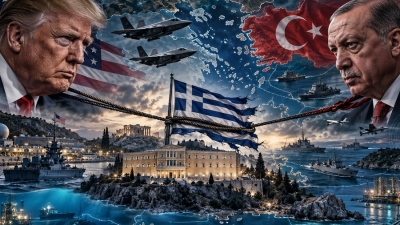
At the same time that Washington upgrades military cooperation with Greece, the administration of Donald Trump continues to pursue close understanding with Turkish President Recep Tayyip Erdogan.
American discussions regarding the potential lifting of CAATSA sanctions and the prospect of Turkey's return to advanced American defense procurement programs reveal that Ankara remains vital to the designs of the United States.
Washington does not view Greece as a replacement for Turkey.
Turkey possesses geographic access to the Black Sea, substantial military power, and the capacity to project influence across critical fronts in the Middle East, Syria, and the Caucasus.
Consequently, strengthening ties with Greece does not signify the abandonment of Turkey.
On the contrary, American strategy seeks to maintain functional relations with both nations.
From Washington's perspective, this policy is understandable: it serves the flexibility of the American presence in the region.
From a Greek viewpoint, however, it creates a substantive contradiction.
Greece regards Turkey as the primary source of threat to its national security, whereas the United States regards it as a difficult but indispensable ally.
This opposition cannot be erased through joint statements of friendship.

The undersea power cable and the limits of American assurances
The electrical interconnection between Greece and Cyprus, with prospects for extension toward Israel, constitutes a characteristic example of the constraints of American backing.
Marco Rubio expressed a positive stance toward the project and cited the possibility of diplomatic assistance to advance it.
Concurrently, however, he underlined the importance of direct, discreet discussions to manage differences.
The project is not merely an investment in energy infrastructure.
It is intertwined with sovereign rights, maritime zones, and regional energy architecture.
Turkey challenges activities in specific maritime areas, invoking its own claims regarding maritime jurisdiction and its memorandum with Libya.
For Athens and Nicosia, the stakes extend beyond laying a cable: they concern the capacity to exercise lawful rights free from external interference.
American political support may prove useful.
It does not, however, constitute a standalone guarantee that Turkey will abandon its objections or that the United States will shoulder any cost to complete the project.
Here the trap of excessive dependence becomes apparent: Athens may regard American support as a strategic guarantee, while Washington treats it as one among many tools of regional bargaining.

NATO is not an arbitration mechanism for Greek-Turkish disputes
Another problem concerns expectations cultivated around the role of NATO.
The Alliance possesses mechanisms to prevent military incidents between Greece and Turkey, including the deconfliction mechanism established in 2020.
However, NATO is not an adjudicative body for resolving questions of the continental shelf, EEZ, or territorial sovereignty.
Nor does Article 5 of the North Atlantic Treaty provide a simple and automated mechanism of military protection when two member states confront one another.
The Alliance's priority is avoiding internal conflict that would undermine its cohesion.
This means that allied management of a Greek-Turkish crisis may aim primarily at rapid de-escalation rather than vindicating Greek positions.
Greece, therefore, cannot substitute its own national strategy with the expectation that NATO will settle its disputes with Turkey.

Greece needs alliances, not unilateral alignment
Deepening ties with the United States can offer Greece military, technological, and diplomatic advantages.
The issue does not lie in cooperation itself, but in its potential conversion into a one-dimensional foreign policy.
An effective Greek strategy ought to leverage the American relationship without diminishing the importance of European defense, partnerships with other regional powers, the domestic defense industry, and independent diplomatic initiative.
Strategic autonomy does not imply estrangement from the West.
It means the capacity to shape national choices even when they do not align completely with the priorities of stronger allies.
Greece has no interest in becoming a proving ground for strategies decided exclusively in Washington, nor in assuming that every upgrade of the American presence represents an adequate return for its own geopolitical utility.
The true test will come in the next Greek-Turkish crisis
The core of the current US-Greek rapprochement will be tested when a serious conflict of interests arises between Athens and Ankara.
Then it will become clear whether American reassurances possess substantive political weight or whether Washington will seek an equilibrium preserving Turkey within the Western strategic architecture, even if that fails to satisfy Greek objectives.
Geography explains why Greece is important to the United States.
It does not prove, however, that the United States will adopt Greek positions on every vital matter.
Washington wants a strong Greece serving the stability of NATO's southeastern flank.
This is not necessarily identical to a Greece enjoying complete independence of choices from American strategy.
This is the fundamental contradiction that Greek foreign policy must confront.
Because the value of an ally is not measured solely by the weapons procurement programs it buys, the military facilities it cedes, or its willingness to partake in superpower designs.
It is measured also by its ability to negotiate, demand reciprocity, and retain the freedom of its decisions.
The greatest strategic error for Greece would be confusing its utility to the US with unconditional US backing for Greece.
And the real question, following the visit of Marco Rubio, remains unyielding: when Washington must choose between keeping Turkey inside the Western sphere of influence and fully supporting Greek positions, which priority will prevail?
Until a convincing answer is provided, Athens has every reason to pursue strong alliances, but no reason to treat dependence as synonymous with security.
www.bankingnews.gr











Σχόλια αναγνωστών